Car A/C feels simple from the driver’s seat: you press a button, and cold air shows up. Behind the scenes, it’s a tight loop of pressure changes, heat transfer, and airflow that has to work while the vehicle vibrates, heat-soaks, and bounces over potholes.
When any one piece of that loop is slightly off, cooling can fade in ways that are hard to describe. Understanding the basics makes it easier to spot why a car system tends to leak more than the one cooling your house.
Once you see what the system is fighting every day, the leak part makes a lot more sense.
How Automotive A/C Makes Cold Air
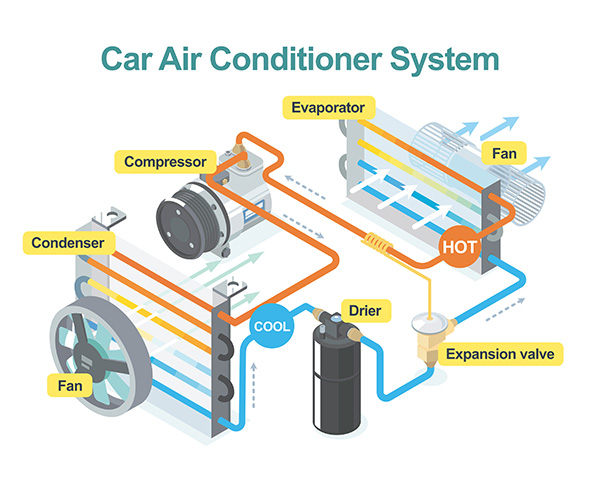
Your car’s A/C does not create cold so much as it moves heat. Refrigerant circulates through a closed loop and changes pressure as it moves, and those pressure changes control temperature. Inside the dash, the refrigerant absorbs cabin heat at the evaporator, and the blower pushes air across that cold surface into the vents.
Then the refrigerant carries that heat forward to the front of the car. At the condenser, it releases heat to the outside air and returns to the cycle. If airflow through the condenser or evaporator is weak, the system can be working but not delivering strong cabin cooling.
The Key Components Under The Hood
The compressor is the pump that keeps refrigerant moving and raises pressure so heat can be dumped at the condenser. From there, refrigerant travels through lines and a metering device, often an expansion valve or orifice tube, which drops pressure before it reaches the evaporator. That pressure drop is what allows the evaporator to get cold enough to pull heat from the cabin air.
Most systems also include a receiver-drier or accumulator that manages moisture and helps keep the refrigerant clean. Service ports, seals, and O-rings at each connection help keep the loop sealed. When cooling fades, we see the problem traced back to either lost refrigerant mass, poor airflow, or control issues that keep the compressor from doing its job consistently.
Why Home A/C Systems Leak Less
Home A/C systems usually live a calmer life. The tubing is often rigid copper with brazed joints, and those joints are not constantly flexing. The outdoor unit sits in one spot, vibration is limited, and the refrigerant circuit does not have to handle an engine moving on mounts a few feet away.
Home systems also have fewer quick-connect points and fewer components exposed to road damage. The condenser is protected by placement, not a front grille that catches rocks and debris. When a home system leaks, it often does so slowly, but it is not being pushed by constant motion and temperature swings the way a vehicle system is.
Why Car A/C Systems Leak More Often Than Home Systems
A vehicle A/C system is built to survive movement, but movement still takes a toll over time. Rubber seals age, O-rings flatten, and flexible hoses allow slight permeation that rigid copper lines do not. Add in daily heat cycling from a hot engine bay, and the sealing surfaces are constantly expanding and contracting.
Here are the most common reasons automotive A/C systems develop leaks sooner:
- Vibration and engine movement stressing seals and fittings
- Flexible hoses and multiple connections compared to rigid home lines
- Service ports and caps that can seep if they are worn or loose
- Condensers exposed to rock impacts and road debris up front
- Compressor shaft seals that can age and seep over time
None of this means a car A/C is fragile. It just has more opportunities for a small seep to start and slowly turn into a noticeable performance drop.
Early Signs Your System Is Losing Charge
Most leaks start gradually, not suddenly. Cooling may be fine in mild weather but struggle on hotter days, or it might feel colder while driving and warmer at stoplights. Frequent compressor cycling can also be a hint that pressures are drifting out of range.
Another clue is a pattern of needing refrigerant again after a recent recharge. Refrigerant does not get consumed, so repeat low charge points back to a leak that was not sealed. If you notice oily residue around a fitting or at the condenser area, that is worth checking because refrigerant carries oil through the system.
How To Keep Your Car A/C Sealed Longer
Running the A/C periodically helps keep seals from drying out, even in cooler months. Keeping the condenser area clear of debris helps the system run at healthier pressures, which is easier on seals and hoses. A clean cabin air filter also helps airflow so the system is not forced to work harder than it needs to.
This is where regular maintenance makes a difference, especially if it includes checking fan operation and hose condition during an inspection. The goal is to catch a small seep before it becomes a low-charge situation that stresses the compressor. Avoiding stop-leak products also protects the system from internal contamination that can create bigger problems than the original leak.
Get Car A/C Service In West Palm Beach, FL, With Military Brake & Alignment Services Inc.
Military Brake & Alignment Services Inc. in West Palm Beach, FL, can check your A/C performance, pinpoint whether the system is losing charge, and recommend the right repair based on what the pressures and components are actually doing. We will also look at airflow through the condenser and verify that the system is charged correctly so you get consistent cooling.
Book a visit when you want cold air that stays cold.